Opening Up the Parallax Archive

This week we start putting up our old shows on YouTube. A full episode every Monday. Free to watch.

We’ve made documentaries for broadcasters like Discovery Channel and National Geographic for more than 30 years. Most of those films aired a few times and then sat on a shelf. On Sunday afternoon we sat down to talk about why we’re putting them out now and about some of the places they took us. Here is part of that conversation, lightly edited.
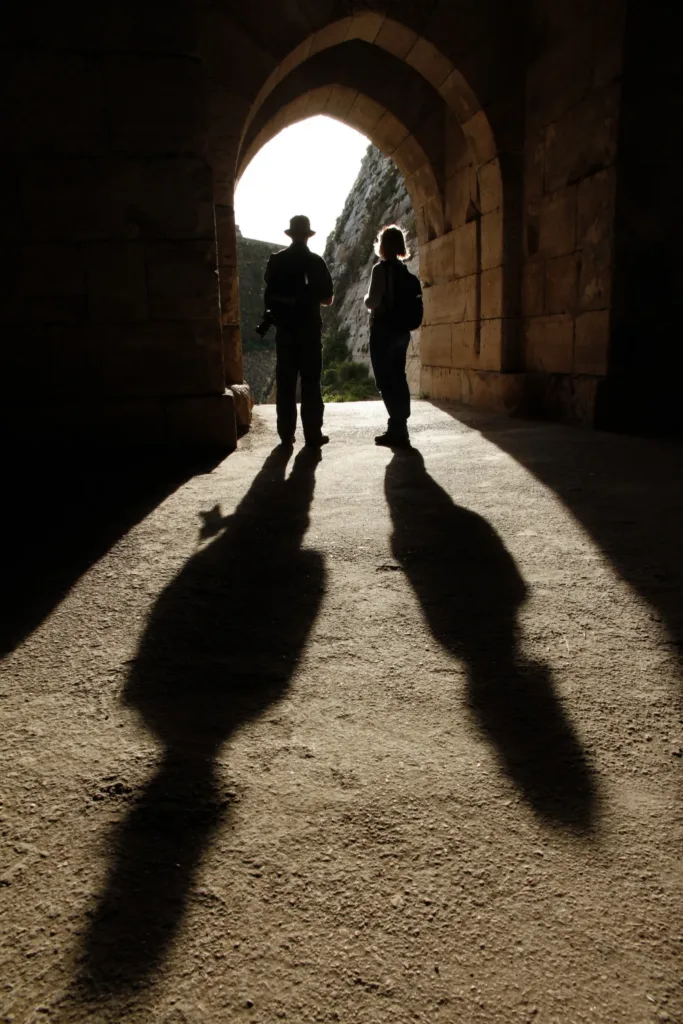
At Crac des Chevaliers in Syria, photo by Sean White

Ian, why now?

Ian: We have time. We’ve stopped making new shows. These ones are sitting on a shelf. A digital shelf.

Then came HMCS Robert Hampton Gray. The ship was named and commissioned over the last year. We put up a few clips. Those posts did well on Facebook and YouTube. That gave us real incentive to get the rest of the library out.

These shows were made for an international audience. They weren’t huge breakout hits. They were Steady Freddy. Good entertainment. Really well done. Decent budgets. We never slid into the reality TV stuff. This is solid documentary in the traditional sense. So let’s get it out there.

If you missed it, you missed it.

Maija: It’s been fun going down memory lane with all these shows. I did a rough count. We’ve filmed in about 30 countries outside Canada. Every show had something. A shot that was really hard to get for whatever reason.

When a show first aired the broadcaster might have the rights for five years. But the chance of anyone seeing a particular show on a given channel was pretty small. In those days if you missed it, you missed it.

This is the first time we’re putting them out as our own. A show might run 45 minutes but take us a year or two. Sometimes three. Thousands of hours of filming, travelling, editing and writing. They were all handcrafted. There are so many great backstories. Now we can tell them.

Ian: The broadcasters had a lot of say in the topics. They also controlled where, when and how often a show aired. After a few airings they shelved it. They had it for three or four years and it never saw the light of day again. Now we can share it with anyone who can get on YouTube.

Maija: We can’t put everything up yet. Broadcasters still hold the rights to a lot of our more recent shows. So this is the older Parallax archive plus Season One of Hell Below.

Discovery Dan

Maija: I’m proud these shows were on Discovery Channel back when Discovery was an amazing platform for a certain kind of storytelling. Remember Discovery Dan? He was smarter than the average bear and really curious about his world. Our shows were made to feed that person.

Ian: Back then this content was hitting the right platform. Now those channels are diluted and split into subchannels. It’s lost in the noise. So this brings the Discovery Dan content into one spot where we talk to that person.

Maija: One of my favourite comments came from someone at History Channel. They told us: “You guys are too history for History.” I thought: Oh my goodness. The landscape has changed.

Ian: They lost the thread. Everybody went into reality. We managed to stay away from that. Thanks to National Geographic.

Maija: Into the Death Zone was our first series. It aired on Discovery in Canada. Then National Geographic International picked it up. That was 2000. So we’ve worked with Nat Geo for 26 years. It’s been our longest broadcaster relationship and a really positive one.

Ian: Our Nat Geo team in London was Hamish Mykura, Sue Davidson and Ben Noot. They invested not just in the content but in us as filmmakers. That let us guide viewers through the engineering or the military campaign.

Maija: Our last ten years have been so prolific and so creatively satisfying. That is a complete credit to National Geographic.

Is there a place that stands out?

Ian: Russia. Our first film as Parallax was about grizzly bears in Kamchatka. The area had been closed for decades because of a submarine base. Hardly anyone had been in there. The bears were really big and beautiful.

Then Alberta for Blowdown. I saw a part of Canada I don’t often get to see. And the people were amazing. So talented and hardworking.

And the Bahamas. We shot more than 100 days over a year. All outside the tourist track. You think of the Bahamas as all-inclusives. We went outside those walls. These shows got us into places most people never get to see.
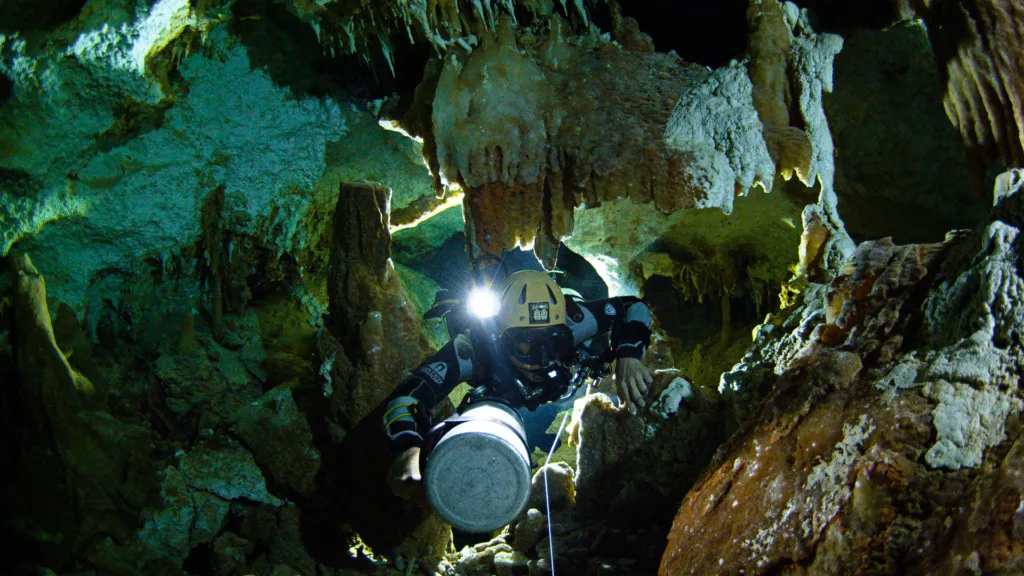
Cave diver with a helmet light swims through an underwater cave in the Bahamas past stalactites and rock formations.
Bahama Blue: cave diving in the Bahamas

What’s the craziest place you’ve put a camera?

Ian: It started with Sinking an Aircraft Carrier. We mounted three cameras on USS Oriskany as it sank. Back then there was no wireless. Somebody had to go in afterwards and get them.

On the carrier only one of our cameras survived. The US Navy had a big recording setup on the deck in a floating box full of electronics. The explosion lifted it up, smashed it on the deck and shut it all down. Our little drugstore camera in a tube was the one that survived.
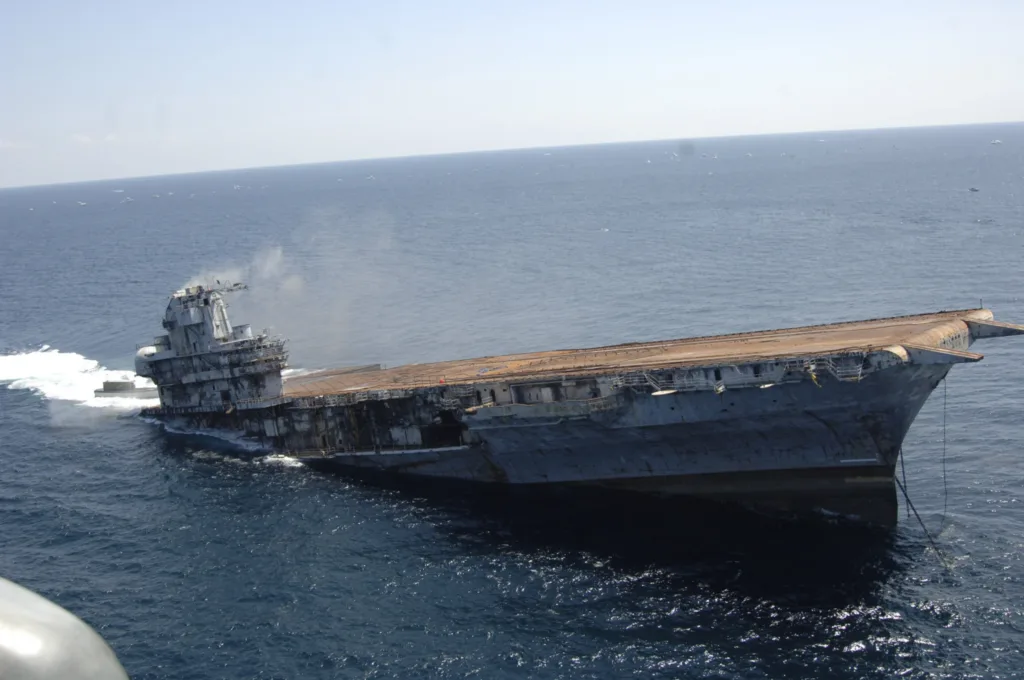
The aircraft carrier USS Oriskany lists to one side as it sinks in the Gulf of Mexico, with spectator boats on the horizon.
USS Oriskany sinking off Pensacola, Florida, in May 2006.

Ian: Then we took that into the Blowdowns. We had cameras ride the rubble down as the buildings exploded. Sean White and the team put drugstore camcorders in a box with a recorder. They zap-strapped and duct-taped it inside a tire so it would survive the fall. These were one-off events worth millions. We always got the shot.

Maija: We have to add the eagle. We did a show about urban bald eagles. There was a rehabilitated eagle that was trained to fly off and come back. We put a camera on it. So we have footage of the city from the eagle’s point of view.

Ian: We weren’t pretending it was a drone. It’s an eagle with a camera on it. This is what the eagle sees.

The hardest shoot?

Maija: You’d probably go back to the Grizzlies.

Ian: It was hard on so many levels. The Cold War had just ended and the peninsula had just opened up. It’s about the size of Vancouver Island. Getting into the country with our equipment was hard.

The biologist guiding us was an outspoken critic of the trophy hunting there. Big money. North Americans flew in to hunt. The Russian officials and local oligarchs came after him and us. At one point we were interrogated. A bottle of Crown Royal came out and smoothed things over. It bought us two weeks before we were going to be thrown out of the country. We got everything done in those two weeks.

Over eight weeks I shot only eleven and a half hours of footage. Every frame was precious.

Maija: And you shot it on film. You don’t know if it’s in focus. You don’t know anything until much later.

Ian: It was months after we finished. Each roll holds less than ten minutes. I’d run through the airport with a backpack full of film to make my gate. Coming out through Alaska they wanted to check the film. Somehow I talked them out of it. It was really close to being lost right there.

Maija: Our blowdown crews had their own airport problem. They’d spend weeks with a demolition team. Then airport security would swab their bags for explosives.

Ian: Back then the explanations seemed to pass.

Sen Toku

Ian: Sen Toku was another tough one. We found Japanese submarines at the bottom of the sea off Nagasaki. The Americans sank them on April 1, 1946 during Operation Roads End. We had one of the first ROVs. It ran on a cable about 600 feet down. It got tangled around the conning tower. It was a miracle that Brett Phaneuf was able to guide it out with the footage.

Maija: And we’d rented that ROV. If we’d lost it we’d have had quite the insurance claim. It had to be shipped ahead to Nagasaki. It had to get onto a boat that would take it and arrive in good shape.

Ian: I remember telling Brett: if this thing gets tangled, make sure we get really good footage. If we’re going to lose it, let’s go out in a blaze of glory.

A crew member in a yellow life jacket leans over the side of a boat to launch a yellow ROV into the sea.

What’s changed since you filmed?

Maija: The shows are time capsules. Years after Blow Out I talked to Maurice Engman from Key Safety. He said: “Maija, we’ve not had a gas well fire since.” If we hadn’t been filming that day we wouldn’t have had that episode. And we only had three in the Series! We would have had to find something completely different.

I checked my messages after coming back from a long weekend wedding and called Ian. Something had finally happened. He left the next morning and we shipped a camera out after him.

Ian: There aren’t many–if any–other films from inside a gas well fire. We caught the end of an era. Safety has taken over in these jobs,  thank goodness. They’re still dangerous but the safety around them is immense.

Maija: Salvage Divers came from a newspaper story. The ship, New Carissa had wrecked off the coast of Oregon. I phoned one of the contractors. He said sure, come down. These days nobody would let us anywhere near it.

I think of Salvage Divers as a bit like Romeo and Juliet. Every time I watch it I want the ending to be different. Spoiler alert, it’s one of the few shows we made where things didn’t go the team’s way.

Ian: Man against nature. As Joe Coyne said: you can’t have hubris in the face of nature. Nature always wins.

Maija: It took courage from that Discovery Team. These were real stakes and real outcomes.

Ian: We didn’t manufacture anything. We just documented. Those teams let us in the room when things weren’t going their way. They let us see them as regular people trying to do a really tough job. Today these stories happen behind a veil and a PR team. You can’t get near them. That’s why I’m so excited to share these.

Maija: I hope we’ve done those teams credit.

What’s coming?

Maija: A full episode from the archive every Monday plus some smaller pieces as we go. First up is Sinking an Aircraft Carrier. It did really well when it came out. Why do you think it had that appeal?

Ian: Anything with the words “aircraft carrier.” And a carrier is designed to be unsinkable. So reverse-engineering that captures everybody’s imagination.

Maija: It was so complicated. It was towed from Texas to Pensacola. There were so many chances for things to go wrong. That it worked out in the end was quite a miracle.

Follow up at our Youtube Channel to catch all the updates.

You can watch Sinking an Aircraft Carrier here.
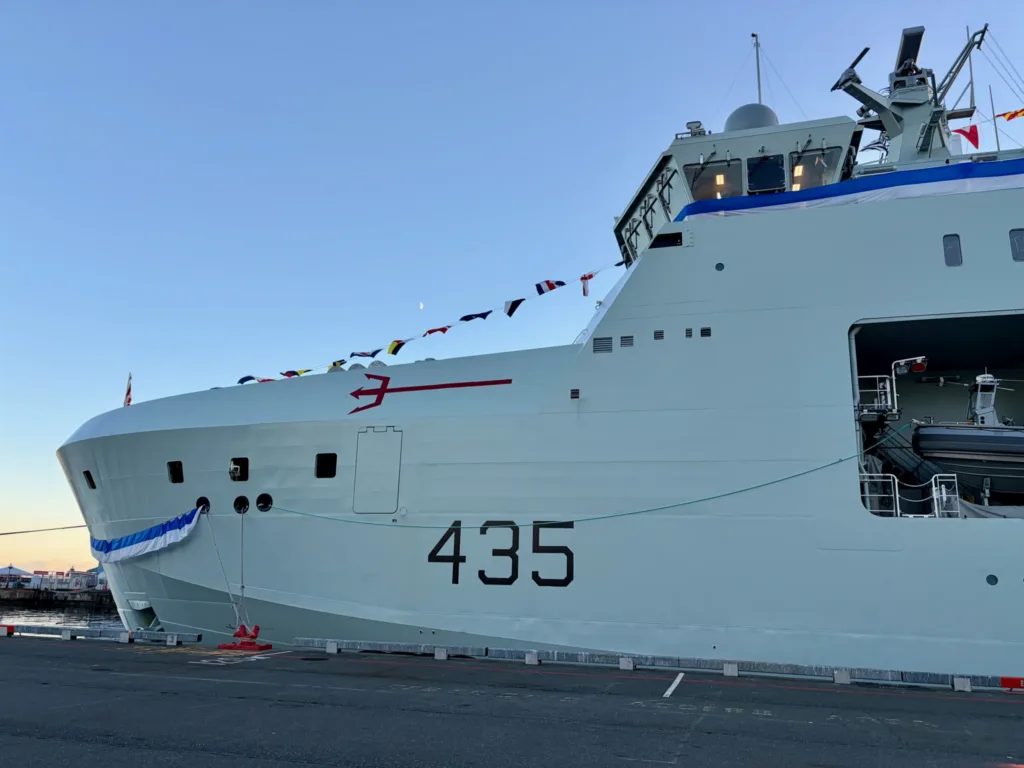
The Ship Came Home: HMCS Robert Hampton Gray

On Monday, November 16, 2026, we were in Victoria, BC for the commissioning of HMCS Robert Hampton Gray. Last year we were in Halifax for her naming.

Lieutenant Robert Hampton Gray was a Canadian navy pilot from Nelson, BC. On August 9, 1945, he attacked Japanese ships in Onagawa Bay and was killed. The war ended six days later. He was the last Canadian killed in combat in the Second World War, and he was awarded the Victoria Cross.

Twenty years ago we made a film about him, The Last Battle of Hampton Gray. After Victoria, we sat down to talk about the film, the two ceremonies and why we’re putting it online now. This is part of that conversation, lightly edited.

HMCS Robert Hampton Gray at her commissioning in Victoria, BC, November 2026
HMCS Robert Hampton Gray, Victoria, BC

Ian, why did you want to make this film?

Ian: It was pretty high drama. Aircraft, battleships, anti-aircraft guns surrounding the bay. In my mind, it was very telegenic. He was the last Canadian killed in combat, and he was given the Victoria Cross. That said this is something important.

I remember pitching it and everyone was a little concerned. They didn’t see it as an important story. For the broadcast world, it was another retelling of a war story that involved one action. I saw it in the bigger scope: how the Canadians were present in the war against Japan. You always hear about the Americans.

The broadcaster wanted someone on camera. Instead of getting an expert, they got me, because Hampton Gray is a cousin.

Maija, what struck you watching it again?

Maija: How emotional it is. Ian was attracted to the action. But rewatching it recently, I thought, wow, this is a crazy story.

We made it for the 60th anniversary of VJ Day. We knew we were getting the last of the veterans. Our links to those people were finite. I still love the scene of two of them with the Corsair. If you squint a little, you can imagine them as young men in the aircraft.

Then there’s Mr. Kanda, and the connections between Canada and Japan, the Kanda family and the Gray family. Even though I knew the whole story, I was surprised how moved I was.

Yoshio Kanda was a young Japanese officer at Onagawa on August 9, 1945. He saw Hampton’s plane come down. In 1989, the Canadians requested permission to build a memorial to Hampton there. Many people in town were against it. After all, Hampton had led the attacks that killed not just sailors aboard the Amakusa, but also local residents. More than 200 people died in the raid that day. Mr. Kanda changed their minds. As he told us in the film, “It was a time of war. And whether people died in Canada or here, it didn’t matter.” The memorial went up that summer. It is the only memorial in Japan to a foreign combatant. Mr. Kanda died in 2005, the year we finished the film.

Memorial service for Canadian naval aviators at the Halifax Memorial, Point Pleasant Park, August 8, 2025

Then came Halifax.

Maija: We arrived on the Thursday. There was a screening of the film that night. Yoshitake Kanda was there, and Jane Underwood, Anne and Marcia George. We hadn’t seen them since Phyllis’s funeral. There was a lot of connecting and reconnecting.

On the Friday there was the ceremony out on the point. All the military pomp: bagpipes, the Lieutenant Governor, the Rear Admiral. A beautiful spot on a beautiful summer day, and the names on those memorials. Then on the Saturday was the naming.

Yoshitake Kanda, Ian Herring, Ibuki Kanda and Marcia George in Halifax, August 2025
From left: Yoshitake Kanda, Ian Herring, Ibuki Kanda and Marcia George in Halifax at the screening of The Last Battle of Hampton Gray, August 2025.

Ian, what was it like to see Yoshitake again?

Ian: He hadn’t aged. It was like time had stopped in the 20 years since we last saw him. When I first met him, he was with his grandfather and his parents. My focus was on Mr. Kanda, so I didn’t really get a chance to connect with him.

In Halifax I realized we hadn’t offended anybody. I was so aware of that when we made the film. I thought, there’s a landmine and I’m going to find it. Two cultures, awkwardly communicating around something so powerfully emotional.

The Japanese ambassador spoke at the naming.

Maija: We were pretty softened up by then. We’d been travelling in a pack with the family for days. We thought we knew what to expect. The wild card was the Japanese ambassador.

He opened by saying he had two things on his calendar that weekend. One was the naming of this ship. The other was the memorial services for the 80th anniversary of the bombing of Nagasaki. Nagasaki was his hometown, which made the choice very hard. He decided to attend the ship naming, understanding it as a commitment to peace and a strong relationship between Canada and Japan today.

He understood the backstory and how these families are woven together. He captured the solemnness and the hope in a way our Canadian politicians just couldn’t. In the end I felt very lucky to have been there.

The story didn’t end with the film.

Maija: Every Canadian navy ship that sails to Japan goes to Onagawa Bay. They visit the memorial to Hampton Gray and the memorial to the sailors who died aboard the Amakusa. If it wasn’t for the memorial, I don’t know that Canadians would go there. And that’s Mr. Kanda. We always come back to Mr. Kanda.

Mr. Kanda had Canadian flags. Every time Canadians came to town, they signed one. It got so full he needed a second.

When the tsunami hit Onagawa, Yoshitake lost his parents. He searched the rubble for anything that might be left, and he found his grandfather’s flags. They had survived.

The tsunami also knocked over both memorials. The town could have let them go. Instead they moved them somewhere safe, so it would never happen again.

And now Victoria.

Maija: Hampton was a BC boy. I kind of feel like this ship came home.

Ian: It was the first time I’d seen him tied to BC in a big way. It’s always been Ottawa, back east.

Maija: It was a much smaller crowd than Halifax. A Monday in November. But we saw the chaplain’s blessing and the crew’s oath, their call and answer: “Ready, aye, ready.” Then we watched the crew board their ship for the first time, as a Canadian Navy ship.

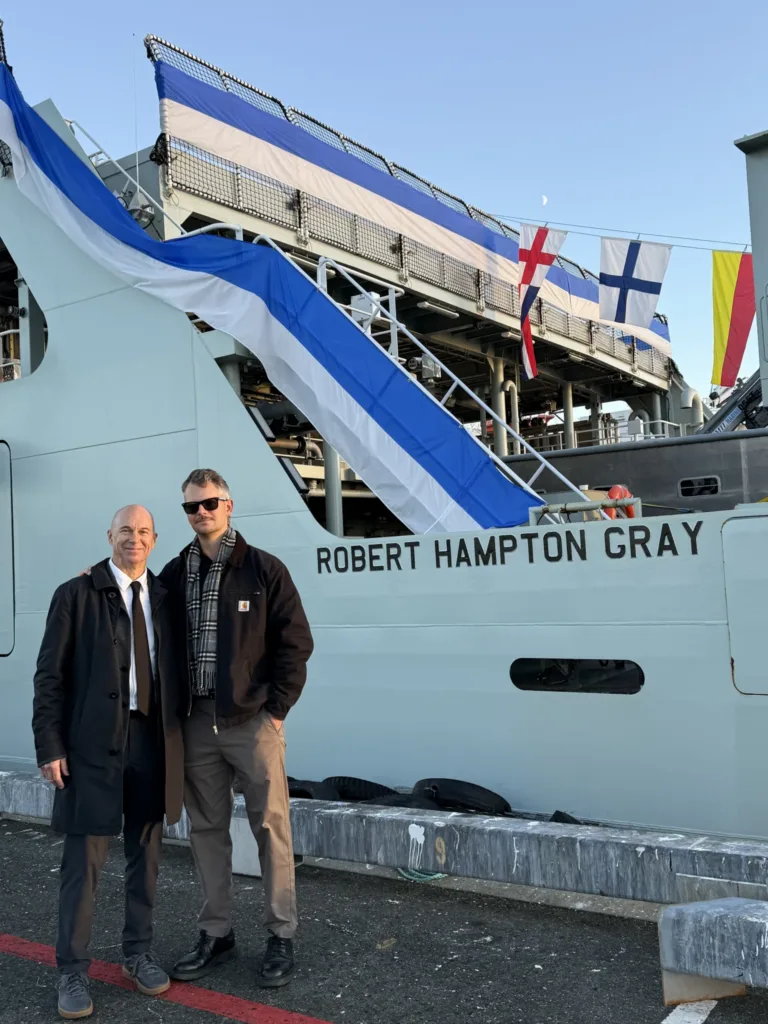
HMCS Robert Hampton Gray, hull number 435, dressed with flags alongside in Victoria, BC, November 2026
Ian and his son Liam at HMCS Robert Hampton Gray, Victoria, November 16, 2026.

Why put the film online now?

Ian: The ship kicked it off. Credit to the Canadian Navy for naming a vessel after him. We made the film 20 years ago and it kind of fizzled. It was never picked up in schools or by historians. The ship brought it back.

Maija: Part of why it fizzled is that Canada doesn’t do war heroes very well. Ask a hundred Canadians to name a Victoria Cross winner. And for most people, the war ended in May 1945. It didn’t end until August. Hampton was also a Canadian serving on a British ship, in a war most Canadians don’t think of as ours. All of that worked against the story.

Ian: The vets are gone. The historians from that time are gone. The family is getting older. There’s a next generation coming up. Yoshitake’s son Ibuki has already given a talk about the story at the Canadian embassy in Tokyo. In the next 20 years it’ll either be picked up by them or not.

Maija: It just keeps going. We’re not done yet.

The Last Battle of Hampton Gray is on our YouTube channel.

Filming the Hell for Hell Below

Last year, Hell Below filmed its principal dramatic re-enactments on board two museum ships: USS Cod, a Gato-class submarine in Cleveland, Ohio and U-995, a Type VII U-boat in Laboe, Germany.

USS Cod in Cleveland, OH

Both locations provided the production with fantastic opportunities to capture an authentic look and feel for the show. A typical day on either set would see 15-25 cast and crew on board. That’s a half to a third of what you might expect to have on a WWII vessel. Needless to say, these spaces are very cramped and make logistics challenging. All camera and lighting equipment had to be hauled on the sets each day and staged in various compartments. It was tough for our small production crew so we can only imagine the logistical realities for the men living and fighting for long periods of time on board.

Sean F. White on Location Aboard HMCS Sackville

We’re always throwing Director of Photography Sean F. White into challenging and foreign environments. Shooting on WWII submarines would prove no different. Our Production Co-Ordintator, Dalila Jovanovic, caught up with Sean and they chatted about some of the demands and rewards of the shoot.

What was the most challenging part of filming at the USS Cod?

“The Conning Tower was the smallest space in the submarine.” recalls White. “We had three days worth of shooting in there. Not only is it a small space but there are plenty of protrusions – the two periscopes, equipment, etc. The bulk of the character filming took place there because that’s where they battled. In addition, heat rises and it all collected there. There was barely enough room to move a meter in any direction with a camera on your shoulder. Lots of dangers to yourself physically but also to the expensive equipment you’re working with, not just our cameras but also the Cod’s fragile museum pieces. Lots at stake and lots to work with.”

In the Conning Tower during the Destroyer Killer Episode

“When we did our depth charging sequences, it was full on. It was noisy and cramped, people are bouncing around. Your intensity level is peaked out. What I find amazing is how cool-headed the actual crew of these submarines must have been, working under these extreme situations in the same cramped, confined spaces. I mean it was challenging enough just filming in there but they had real life and death situations, and the ship would be moving and travelling. I wouldn’t want to do it.”

White continues about his crew, “We are a very tight, small crew that works very well as a unit. Some of the compartments were so tight that we had to stage cast and crew in other rooms. Sometimes the Director, Ian Herring, would be wedged up in the corner of the room on top of an apple crate, watching the scene. It’s far from your feature film scenario with huge tents and cables running everywhere and people sitting down in chairs looking at monitors. This is guerrilla style work but we were all united in the vision of how to achieve it.

What about the set of U-995? How did the U-boat differ from the American submarine? Were there any particular challenges there?

“Well the U-boat was smaller, so there was even less space than the US submarine.” White elaborates, “The US sub by contrast was luxurious – wider spaces for the crew, wider and taller corridors, bigger doors. The U-boat was more condensed. At this point, our crew was more accustomed to submarine the environments. But I think most of my injuries were sustained on the U-boat. We also spent a lot of filming on the deck. The nature of the design for the U-boat made it very difficult to film. We had to strap ladders on the deck and weigh them down. We literally harnessed ourselves on to the side of the submarine to get our shots of the bridge watch. We were about 40 feet off of the ground and spraying water, wind, and smoke.

Production still from "Hell Below" television series (c) 2015 Parallax Film Productions Inc. 1-604-531-2244 Photo by Sean F. White
Production still from “Hell Below” television series (c) 2015 Parallax Film Productions Inc. 1-604-531-2244 Photo by Sean F. White

Was there a particularly fun scene to shoot on set?

White laughs. “Well there was a lot of fun things to shoot. I think that’s what attracted us all to the project, the opportunity to shoot on these very cool subs. One of the highlights from the German U-995 shoot was out on the deck. We actually had the local fire department show up and they brought in these huge hoses and set them up on top of the deck. We had guys re-enacting the Atlantic storms. In some cases, German U-boat crew would actually be swept off the bridge and so they were often harnessed in, like us. We did it in a safe manner and it was very fun. The whole town came out and watched these actors in period pieces just get plastered by these firefighters. Of course, we all got soaked but no one minds getting wet and dirty if you know you’re getting good stuff.”

“Some of the running scenes were really fun to shoot. If there was an emergency on the sub, they would dive and all free men would race to the bow of the sub to help it reach depth faster. We did a bunch of cool scenes where the crew would be running through these various corridors. Following people through these tight spaces really gives you a sense of the submarine. You feel like you’re travelling.”

Hell Below also shot scenes on the HMCS Sackville to represent the British sailors aboard Atlantic convoys and created a Special Effects submarine in Langley, BC, for some of the more action-packed sequences.

Aboard HMCS Sackville in Halifax during the filming of Hell Below

The dramatic re-enactments are a huge part of the series and bring a real sense of authenticity to the visuals. The crew of Hell Below had a small taste of what submarine life might have been like for the young sailors of the Second World War and were fortunate to walk away with some stunning imagery, plenty of stories, and only a few bumps and bruises.

Hell Below is currently airing on Tuesdays on Smithsonian Channel in Canada. The episodes are available for Canadian viewers online for a limited time after broadcast here.

We look forward to announcing more worldwide broadcast dates shortly. Stay tuned!

How to Dress a Submariner

Hell Below was filmed aboard two Second World War era submarines, the USS Cod in Cleveland, Ohio and U-995 in Laboe, Germany. We had great sets, an incredibly talented crew and a wealth of performers to work with.  In order to really bring the visuals to life, we needed to be as authentic as possible with the period costuming.  Our talented Production Coordinator and Designer Dalila Jovanovic tells us how to dress a submariner.

At first, the insignia, ranking systems, and even the hue of the uniforms, was daunting.  After many hours of research, I breathed a sigh of relief as both the American and German submarine uniform requirements were much less rigid once sailors left port.  The men would pack away their best clothing for their return to base.  On board, they were able to wear whatever made them most comfortable.  For the Americans, this usually meant khakis, t-shirts, undershirts, etc.  Aboard German U-Boats, it would appear that they usually dressed down their battledress.

Sam Dealey and his Crew Aboard USS Harder

The American costumes were easy enough to replicate.  Our friend Paul Farace at the USS Cod provided us with many of the American khakis seen in the show.  In our Destroyer Killer episode, we borrowed authentic battledress from one of our re-enactors to replicate what a group of Australian commandos might have worn for a rescue mission.   All in all, Cleveland was good to us.

The real challenges came with our German episodes.  While the Kriegsmarine active duty wear was “casual”, we still had to replicate their battledress and source the proper caps for a number of Commanders.  Luftwaffe and SS Officer uniforms are fairly accessible but the U-boat costumes are a truly niche market.  After many sketchy website visits, we started building costumes by U-boat compartment.

There were a number of looks that needed to be replicated.  The Deck Watch crew might wear one of two options.  The first a sleek, grey leather reefer style jacket.  The second being foul-weather wear, consisting of sea-boots, black over-trousers, large waterproof black coats, balaclavas and sou’westers.  This was designed to help crew brave the Atlantic weather on the deck.  Crew below deck often wore sweaters or a “Canadian lumberjack”/ plaid civilian shirt.  The Commander of the U-boat would wear his white peaked cap to show his status.

Production Still from HellBelow: The Wolfpack

In the end, the Kriegsmarine battledress uniforms were a patchwork of hipster flannel shirts, Dickie’s grey trousers, U-Boat war badges ordered from memorabilia websites, caps hand-sown with various rankings, and custom made battledress ordered from international suppliers.  The deck crew costumes were a medley of strange Ebay purchases from London to Texas, white towels, dollar store balaclavas and Helly Hansen pants and sou’westers.

And it worked.

The power of the German uniform, even at it’s most Kriegsmarine casual, didn’t really hit me until we marched our re-enactors from holding base to our set at U-995.  Heads turned.  Lights came on in the hotel rooms as people stood-by watching.  Something in the air changed. For a few hours each day, we were able to really imagine and feel the weight of it all.

Production Still from Hell Below: Hitler's Revenge
Production Still from Hell Below: Hitler’s Revenge

Hell Below is currently airing on Tuesdays on Smithsonian Channel in Canada. The episodes are available for Canadian viewers online for a limited time after broadcast here.

We look forward to announcing more worldwide broadcast dates shortly. Stay tuned!


The War Took Them to Hell Below

It was an exciting week at our Parallax offices. After months of hard work, the first episode of our news series, Hell Below was broadcast in Canada on Smithsonian Channel Canada. We started production last May in Cleveland, OH aboard the USS Cod, a vintage, World War II era submarine that is now a Museum. It was a thrill to climb down through the hatch and down the ladder, listening to the metal echo with each step. The smell of hydraulic fluids and diesel infuses your clothes if you spend enough time there. To serve abroad the sub with a crew of more than eighty men seems incomprehensible. Visiting is an experience we’d recommend for everyone.

Commander Dudley Morton and Executive Officer Richard O'Kane Play Cribbage Aboard USS Wahoo
Commander Dudley Morton and Executive Officer Richard O’Kane Play Cribbage Aboard USS Wahoo

It was amazing to be there as we filmed the dramatic recreations for our shows. The young men in uniforms, crowded into the Conning Tower, raising and lowering the periscopes. The Museum maintained its regular operations while we filmed and the patrons also seemed bemused by our “sailors”.

“Make a hole and make it wide!” someone would yell to let the groups pass our cast and camera crew. We sat at the Ward Room table in what you’d consider the Officers Mess planning scenes and brainstorming shots. A faint shiver went up my spine when we turned on the record player and we dropped on an album imagining the crew doing the same thousands of miles from home and far out at sea.

Over the summer our crew also travelled to Laboe, Germany which is home to U-995 a rare example of a serving U-Boat, which we were also lucky enough to film aboard.

U-995 in Laboe, Germany

Smaller than its American counterpart, the Type VII’s were the most widely produced submarine just before and through World War II. Life aboard the U-Boats was definitely more austere. Their fresh water was essentially only used for drinking. Shaving, showering and laundry waited until the crew was ashore after their 60+ day patrols. Halfway through the submarine Commander would have the sheets turned over for the return trip home.

Each of the episodes of Hell Below tells the story of a different submarine patrol or in the case of one episode, a convoy battle. We join the adventures of USS Wahoo in our episode America Fights Back, USS Tang in Fatal Voyage, USS Harder in Destroyer Killer, U-99 in The Wolfpack, U-123 in Hitler’s Revenge and the attacks on Convoy HX-229 in Atlantic Showdown. You can check our the series title sequence below:

Hell Below is currently airing on Tuesdays on Smithsonian Channel in Canada. The episodes are available for Canadian viewers online for a limited time after broadcast here.

We look forward to announcing more worldwide broadcast dates shortly. Stay tuned!

BahamaBlueTV: Diving with Sharks at Night

Interview with Mark Rackley cameraman and freediver/shark diver

As one of the most extreme underwater cameraman in the world, Mark Rackley, an experienced freediver, can hold his breath for over five minutes to depths of up to 150ft! Rackley likes to get up close and personal with his favourite underwater subject: the shark. Rackley is not only a fearless shark diver, he is also their advocate, and wants to dispel the misconceptions surrounding this misunderstood sea ‘monster’.  Mark worked underwater for Bahama Blue filming reef sharks and reveals what it was like to interact with these ancient creatures in the depths of the Bahamian ocean, after dark.

What was it like diving with sharks at night?

It was great! An unbelievable experience to have all those Caribbeans (sharks) around. Any time you are working with wild animals, it gets crazy, there are all kinds of different scenarios you go through. It’s definitely more challenging at night because they can see you but you can’t see them.  It’s basically pitch black at night and you just have your personal lighting. You can only see the creatures that enter into the dome of the light, everything else is shadowed.

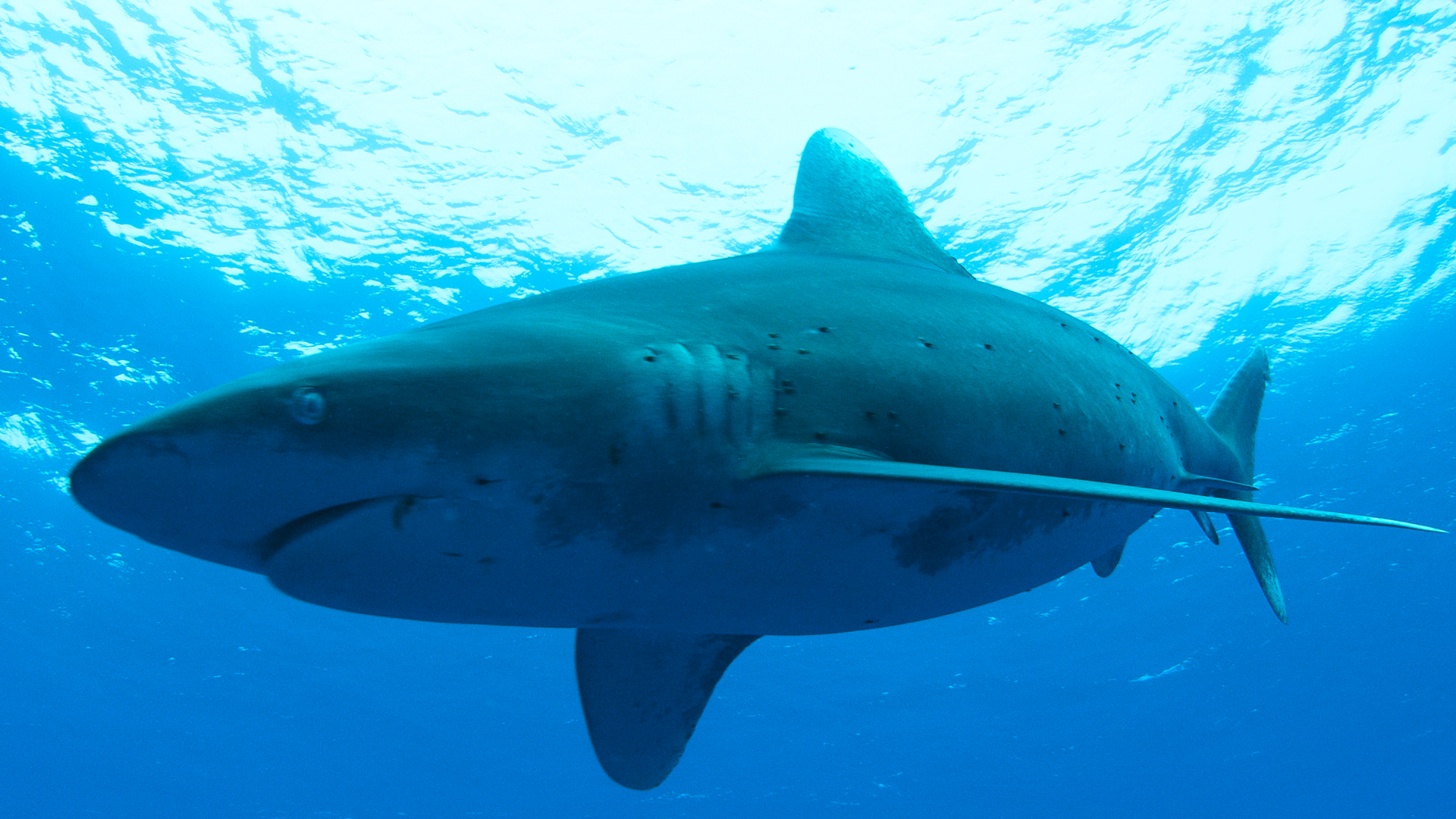
Nightime Shark

What role did the local Bahamian community play?

They were a great help and indispensable to have with us. We worked with a local charter, Stuart’s Cove.  It was a challenging shoot but so much fun being in the water and the whole crew was helpful.  That makes it a lot easier when everybody is putting their heads together to solve problems as we surfaced.

Were there any surprises during the shoot?

The big Black Groupers! 60 pounds plus! They were getting cleaned at a cleaning station. That was probably the most exciting event. I am a spear fisherman, but you don’t often see that.  To get up close just see how beautiful they can be…wow!

The grouper fish lives in the drop offs in the Bahamas. It was amazing to see sharks and groupers swimming together.

Grouper New

Why do you like shark diving?

I have done this my whole life and will continue. I like the excitement. There is something new and different every day. People enjoy watching the footage I take and I like watching it too!

It’s a great way to connect with the environment and this unique ecosystem.

What are the major misconceptions people have about sharks?

Some people are afraid to jump in the water because they think a shark is just going to bite them. But that isn’t the case at all. They are after food, not because they have a malicious intent to kill a human. That is the biggest misconception.

They each also have their own personalities, some are definitely friendlier than others.

What fascinates you about sharks?

First of all, all of the animals in the water are fascinating, but yeah sharks are so precise at what it does, and interesting looking. The way it swims through the water is just a beautiful!

How did you feel swimming in the dark with sharks?

It’s a whole different feeling. You kind of get beside yourself and ask, “Is this for real?”  I don’t take doing this for granted, not one day. There are consequences and dangers every time I get in the water.

How can people learn to respect sharks?

By enjoying the stuff that Bahama Blue is doing, this visual documenting the Bahamas makes it real for people. That helps.

Swarm of Thimble Jellyfish present clearly against darker nighttime waters
Swarm of Thimble Jellyfish presents clearly against darker nighttime waters

Thanks Mark! More about Mark Rackley@ www.markrackleyproductions.com

Experience day and night on a CORAL reef colony, and find out who is best hidden away when the sun goes down and the come sharks out!

Bahama Blue is a six-part documentary series created by award-winning producers Ian Herring and Maija Leivo of Parallax Film Productions. Bahama Blue airs in Canada May on the Love Nature channel and also on Animal Planet around the world.

Interview with Andy Casagrande for World Oceans Day

Andy Casagrande on set of Bahama Blue

In the lead up to World Oceans Day on June 8, we spoke with award winning cinematographer Andy Casagrande. Andy specializes in wildlife and natural history documentaries around the world.

Andy’s vision is to inspire people to care about our planet and its vanishing wildlife. For Bahama Blue, Andy filmed numerous underwater sequences with animals like Sperm Whales, Blainville’s Beaked Whales, Manatees, Octopuses and Sharks.

People are always curious about his experiences with the last. Here are Andy’s thoughts about diving with this often misunderstood creature, the shark:

Diving with sharks can be a rather dangerous activity for obvious reasons. Sharks are wild predators that specialize in hunting and feeding on prey that sometimes resembles the same shape & size as a human. Thus, it’s not hard to understand why diving with sharks can be a bit daunting. However, on most occasions, if you use common sense and don’t dive in murky water, don’t dive with bait, avoid contact with the sharks and simply don’t freak out, you can enjoy these surreal underwater encounters with these living sea monsters.

When I say sea monsters, I’m not saying sharks are monsters, quite the contrary. Sharks are simply marine predators that have been around millions of years hunting their food to survive. They are not malicious and menacing, they are merely existing.

I have been diving with ‘dangerous’ sharks worldwide for the past 15 years, with my specialty being Great White Sharks, and luckily, I have never been bitten by a shark. I say ‘luckily’ because yes, luck does play a factor. The bottom line is that every single shark out there is an individual and they all have unique and vastly different personalities. If you are diving with a friendly shark, life is good and you can peacefully share the same liquid space with a majestic top predator. However, If you are swimming with a not-so-friendly-shark or perhaps a hungry or territorial shark, then you should make your safest and calmest exit from the water and stick to watching Bahama Blue instead!

Bahama Blue (c) 2014 Parallax Film Productions Inc.

Every year thousands of people flock to the Bahamas for a relaxing vacation on the beach. Other folks want to add some adventure to their travel. How do you remain safe if you decide to go on a Shark Dive?

Andy has some Ocean Awareness tips for these travelers:

Five Tips for Safe & Successful Shark Dive

1)  Avoid diving in murky water with sharks as this can lead to sharks mistaking you for food.

2)  Dive with experienced shark guides and dive operators and always dive with a reliable dive buddy.

3)  Don’t get too close to the bait – or you just might become the bait yourself 😉

4)  Bring a camera or a small stick to act as a prod, in case the sharks get a bit too “friendly”.

5)  Avoid touching the sharks and use common sense to stay safe and have fun!

Thanks Andy!

World Oceans Day is June 8. This year’s theme is Healthy oceans, Healthy planet.

Saturday May 23rd is the World Oceans Day Tweet Chat with Andy Casagrande. Send us your questions via www.twitter.com/BahamaBlueTV or to our Facebook page at www.facebook.com/BahamaBlue

Bahama Blue is a six-part nature series produced by Parallax Film and broadcast on the Love Nature channel in Canada.

International Broadcast Dates Announced for Bahama Blue

Bahama Blue

As many of you know, Bahama Blue is currently airing in Canada on Love Nature on Wednesdays at 10 pm.  You can also catch up from Canada via their online videos.

Much of Eastern Europe, the Middle East and Africa are also seeing Bahama Blue on their Animal Planet or Discovery Channel television schedules.  Here are some sample broadcast schedules:

Estonia   Poland   Finland

We’ve learned that Focus Italy will begin their broadcast run this Sunday, May 24.  Click here for details.

In Asia we have premiere dates and other information for the following territories:

India – premieres daily at 8pm from Jun 1-8.  We have more details here.

Taiwan – every Mon at 10 pm, starting Jun 8
Australia and New Zealand – every Friday at 7.30 pm, starting Jun 19. Learn more here.
Southeast Asia – every Fri at 9 pm, starting Jun 26
Japan – first episode on Jul 13, 11 pm

If you spot a Bahama Blue listing, let us know on Facebook or Twitter!


Natural History Discovery Made During Bahama Blue Production

This week’s blog post comes from Dr. Elizabeth (Betsy) Stoner who provided loads of information and logistical support to our latest project.  She made an amazing natural history discovery during the production of Bahama Blue and we asked her to tell us what happened.

Betsy reports:

One of the greatest thrills a scientist can have is discovering something “new” in the natural world, such as stumbling across an undocumented species, or witnessing a never-before-seen animal behavior. Though this rarely occurs, I had the fortune to make a discovery regarding two unpopular animals: jellyfish, and venomous worms.

The Upside-down Jellyfish (Cassiopea spp.)

During the filming of “Bahama Blue”, the Parallax team and I were documenting the mangrove jellyfish (Cassiopea spp.), also known as the upside-down jellyfish due to its unique life history orientation.

Although these jellyfish are important animals in mangrove ecosystems, human disturbances can cause these jellyfish to bloom, or increase in abundance, potentially harming other marine animals and plants. A predator could help keep Cassiopea densities in check, but to date, no animal had been recorded killing these jellyfish!  However, during filming in April 2014, as I observed the behavior of a Cassiopea that had settled to the bottom of a mangrove-lined tidal creek on Abaco Island, The Bahamas, an extremely large bristle worm appeared out of the crevices of the coral bedrock and proceeded to devour the jellyfish.

Over the course of the next twenty minutes, several more massive worms appeared and joined the feast, leaving no trace of the jellyfish. This remarkable and dramatic event was captured on film by the Bahama Blue team, which I subsequently documented in following months during a jellyfish feeding experiment.  One theory as to why the worms eat the jellyfish? The worms may incorporate venom from stinging cells found inside the bodies of jellyfish into their own tissues as a defense against their predators. This discovery and the follow-up experimental work was recently featured in the May 2015 Volume of Frontiers in Ecology and the Environment.

Here at Parallax Films we couldn’t be prouder of Betsy and her exciting new research discoveries.  We wish her every success in her future work.  You can learn more about Betsy on her website.

Dr. Elizabeth (Betsy) Stoner is a marine ecologist and jellyfish expert. Her research broadly focuses on human-driven benthic jellyfish blooms and how they influence other animals and plants in coastal marine ecosystems.  Most of her research takes place in The Bahamas, where she is happily nestled in mangrove forests and seagrass beds on a regular basis. When she isn’t getting stung by jellyfish or handling venomous bristle worms, she can be found working in the urban jungle of Miami, FL, helping students who are underrepresented in the sciences pursue their dreams of becoming professional scientists.  

Behind the Magical Moments: Capturing Bahama Blue

IMG_0698-1024x768

For most people the word Bahamas conjures up images of white sand beaches, rum drinks and great sunsets.  But for documentary director Ian Herring, his perspective changed when he visited in 1996 to film lemon sharks.  “We were standing in a Mangrove swamp,” he explains. “There were full-grown sharks over two meters long in this really shallow water.  It was such a contradiction to see them in this way.  I think coming back, to film again, was to reconcile what I thought I knew with what I witnessed.”

Bahama Blue is a six-part series captured in Ultra High Definition cinematography exploring the diverse ecosystems that are stretched across the chain of limestone islands we know as the Bahamas.  In classical documentary form, Bahama Blue focuses on important actors:  the creatures themselves.  With patience, the team was able to locate and film these animals in their natural habitat.  “Our idea is shift away from the humans and just let the animals and their behaviours reveal the story in a fresh and entertaining way,” says Herring.  “The pressure was on award-winning cinematographers like director of photography Sean White, and underwater camera operators Andy Brandy Casagrande IV and Mark Rackley.  Filming a natural history series like this means managing the three W’s:  Weather, wildlife and water.  It’s never routine.”

This also meant finding a balance with arguably the most famous occupants of the Bahamas: their sharks.  “I understand the obsession,” says Herring.  “Having been in the water with them, you really get a sense of their power and how perfectly adapted they are to the ocean environment.”  With at least forty different types of sharks, the Bahamas has become a world leader in their protection, having fully banned the shark trade in 2011.  “What we learned is that when you protect apex predators like sharks, it benefits the whole ecosystem,” he adds.  “So to focus on the other creatures within this environment was also very attractive to me.”

Bahama Blue (c) 2014 Parallax Film Productions Inc.

How does a filmmaker from Canada navigate such a mysterious and diverse place like the Bahamas?

“The best way is through the researchers and scientists.  They are an amazing network of people who have a specialized knowledge of the Bahamas.  It’s not a large community – everybody knows each other and the research that is going on.  Once you get connected to this network, you discover things you never knew existed.  And someone can tell you exactly where to find them or offer to take you there,” recalls Herring.

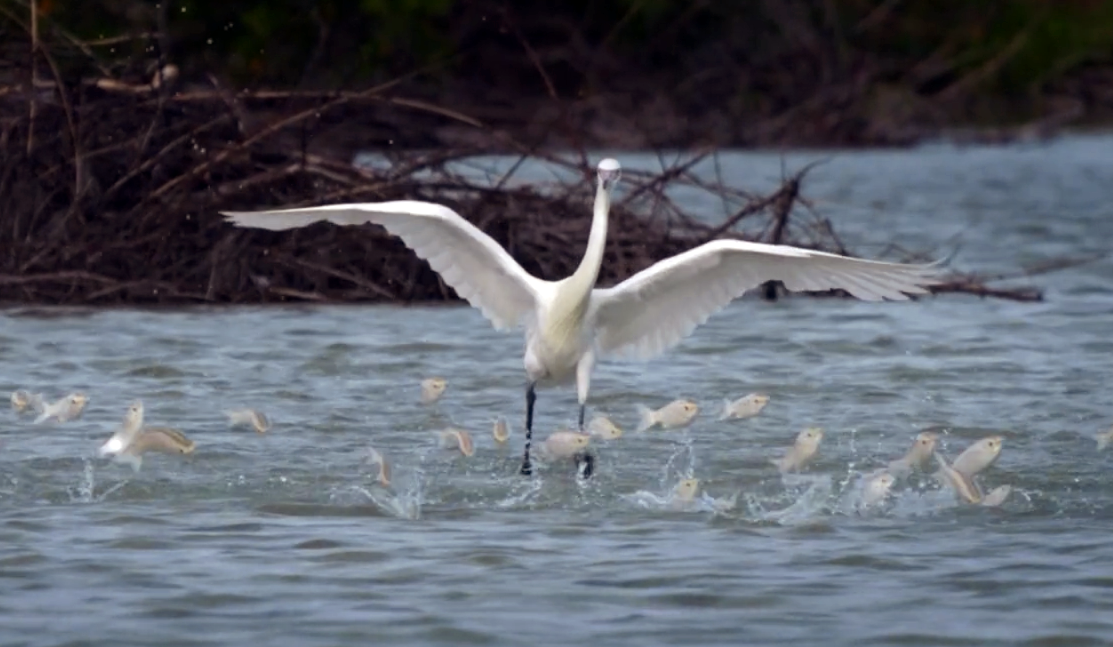
This technique resulted in some lucky finds.  “Birds, for example, are hard to film,” he explains.  “They are creatures of the sky and we are creatures of the land.  But coming back from a day of shooting iguanas with wildlife biologist Joe Wasilewski, he pointed out a solitary bird stalking the tidal flats:  the Reddish Egret, a rare white phase type that stands a meter tall.  “My initial reaction to this was a pretty bird standing on the beach, not much more than that,” remembers Herring.  “But Joe pointed out that the egret had a particular way of feeding.  This shy bird would herd the fish in the shallows and get them corralled in a group, then strike and take out a fish.  It sounded amazing, but it seemed really unlikely that it would do so while we were watching.”

“Our director of photography Sean White was filming juvenile lemon sharks from the beach and they had finally arrived.  He said if we want to film the egret we would have to relocate.  It was a classic filmmaker’s dilemma:  a shark in the hand or a bird in the bush, so to speak. My initial response was, ‘No! Don’t move because this bird will never do what you want in front of the camera.’  Within half a minute of me saying this, it suddenly started its hunting behaviour.  Sean made a quick switch and managed to capture its spectacular leaps and corralling.  It was running through the shallows opening its wings, flapping them and herding this group of fish until they were literally bursting out of the water.  It was fantastic! This was a magical moment in the world of documentary filmmaking that required skill but also came down to listening to the local experts and a bit of luck.”

egret1

In addition to the wildlife, the geography of the Bahamas also provided amazing opportunities for filming.  The Bahamian caves and blue holes are unknown to most travellers to the Bahamas because only certified cave divers are able to access these subterranean features.  On one hand they are easier to film because they are not going anywhere, unlike creatures who may or may not show up.  But on the other hand, you must bring everything you need to survive with you, including air and light to see and film by.

“So the technical challenges make it quite dangerous to film.  But we are not focusing on that in the program, the human danger, ” explains Herring. “We purposefully focus on the geology and special nature of these formations.”

With spectacular imagery, Bahama Blue is both entertaining and educational, drawing the viewer into the lives of elusive creatures, yet highlighting the fragility of the ocean environment.  In a market dominated by character-based television programming, Herring believes that there is still an appetite for natural history programming.  “There is room in our lives for us to be inspired and filled with wonder.  There really is a value to that.”

Bahama Blue was produced by award-winning Canadian producers Ian Herring and Maija Leivo of Parallax Film Productions.

Bahama Blue premieres in Canada on Wednesday May 6, 2015 on the Love Nature channel.

Check out our Facebook page and Tweet us @BahamaBlueTV.