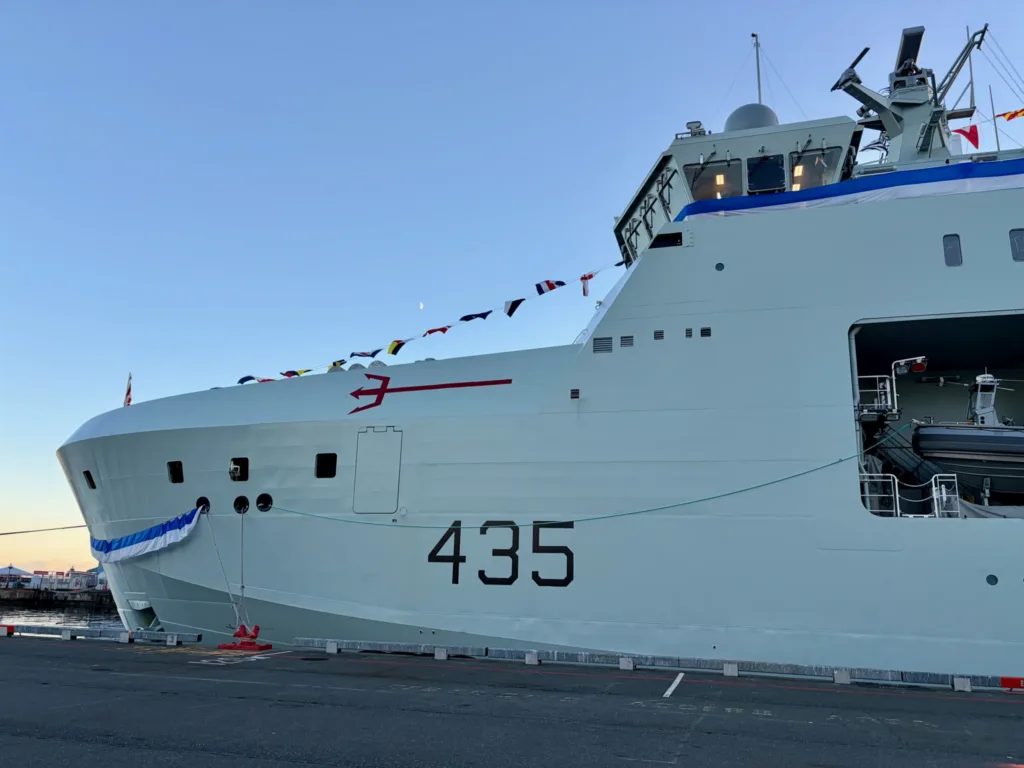
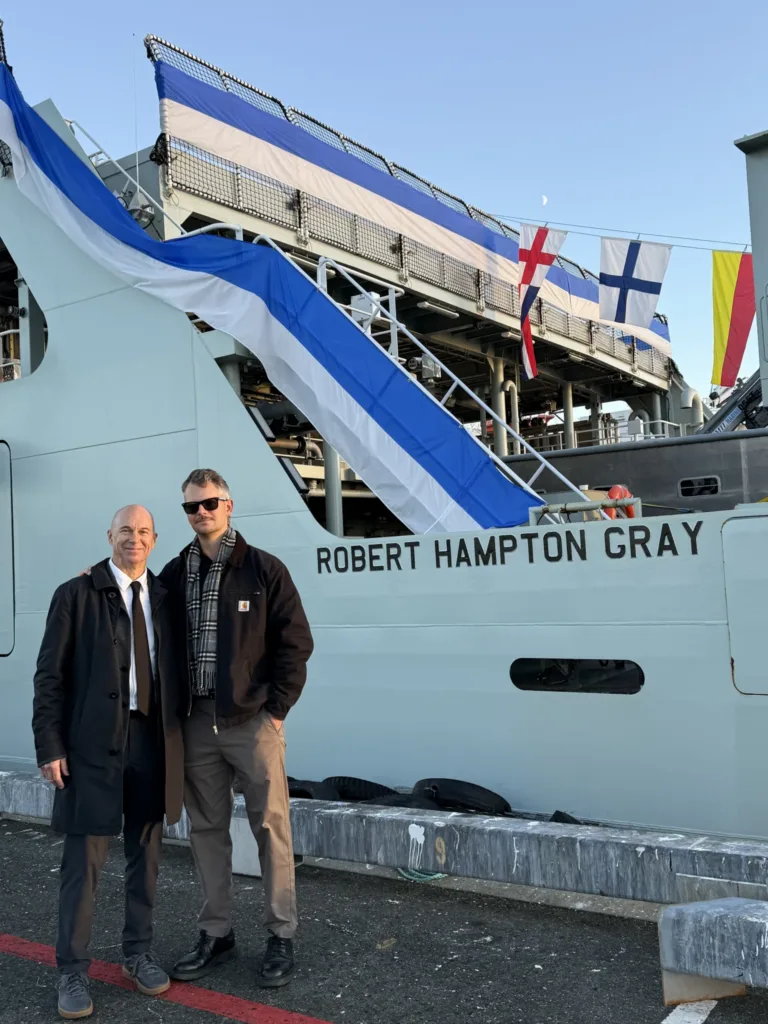
On Monday, November 16, 2026, we were in Victoria, BC for the commissioning of HMCS Robert Hampton Gray. Last year we were in Halifax for her naming.
Lieutenant Robert Hampton Gray was a Canadian navy pilot from Nelson, BC. On August 9, 1945, he attacked Japanese ships in Onagawa Bay and was killed. The war ended six days later. He was the last Canadian killed in combat in the Second World War, and he was awarded the Victoria Cross.
Twenty years ago we made a film about him, The Last Battle of Hampton Gray. After Victoria, we sat down to talk about the film, the two ceremonies and why we’re putting it online now. This is part of that conversation, lightly edited.
Ian, why did you want to make this film?
Ian: It was pretty high drama. Aircraft, battleships, anti-aircraft guns surrounding the bay. In my mind, it was very telegenic. He was the last Canadian killed in combat, and he was given the Victoria Cross. That said this is something important.
I remember pitching it and everyone was a little concerned. They didn’t see it as an important story. For the broadcast world, it was another retelling of a war story that involved one action. I saw it in the bigger scope: how the Canadians were present in the war against Japan. You always hear about the Americans.
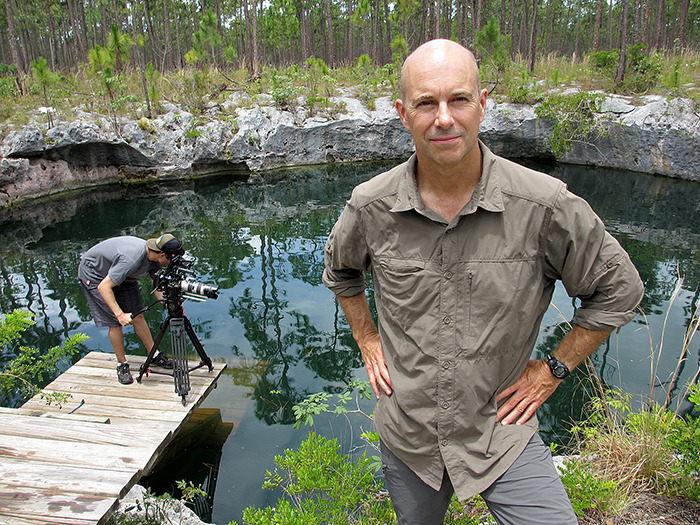
The broadcaster wanted someone on camera. Instead of getting an expert, they got me, because Hampton Gray is a cousin.
Maija, what struck you watching it again?
Maija: How emotional it is. Ian was attracted to the action. But rewatching it recently, I thought, wow, this is a crazy story.
We made it for the 60th anniversary of VJ Day. We knew we were getting the last of the veterans. Our links to those people were finite. I still love the scene of two of them with the Corsair. If you squint a little, you can imagine them as young men in the aircraft.
Then there’s Mr. Kanda, and the connections between Canada and Japan, the Kanda family and the Gray family. Even though I knew the whole story, I was surprised how moved I was.
Yoshio Kanda was a young Japanese officer at Onagawa on August 9, 1945. He saw Hampton’s plane come down. In 1989, the Canadians requested permission to build a memorial to Hampton there. Many people in town were against it. After all, Hampton had led the attacks that killed not just sailors aboard the Amakusa, but also local residents. More than 200 people died in the raid that day. Mr. Kanda changed their minds. As he told us in the film, “It was a time of war. And whether people died in Canada or here, it didn’t matter.” The memorial went up that summer. It is the only memorial in Japan to a foreign combatant. Mr. Kanda died in 2005, the year we finished the film.

Then came Halifax.
Maija: We arrived on the Thursday. There was a screening of the film that night. Yoshitake Kanda was there, and Jane Underwood, Anne and Marcia George. We hadn’t seen them since Phyllis’s funeral. There was a lot of connecting and reconnecting.
On the Friday there was the ceremony out on the point. All the military pomp: bagpipes, the Lieutenant Governor, the Rear Admiral. A beautiful spot on a beautiful summer day, and the names on those memorials. Then on the Saturday was the naming.
Ian, what was it like to see Yoshitake again?
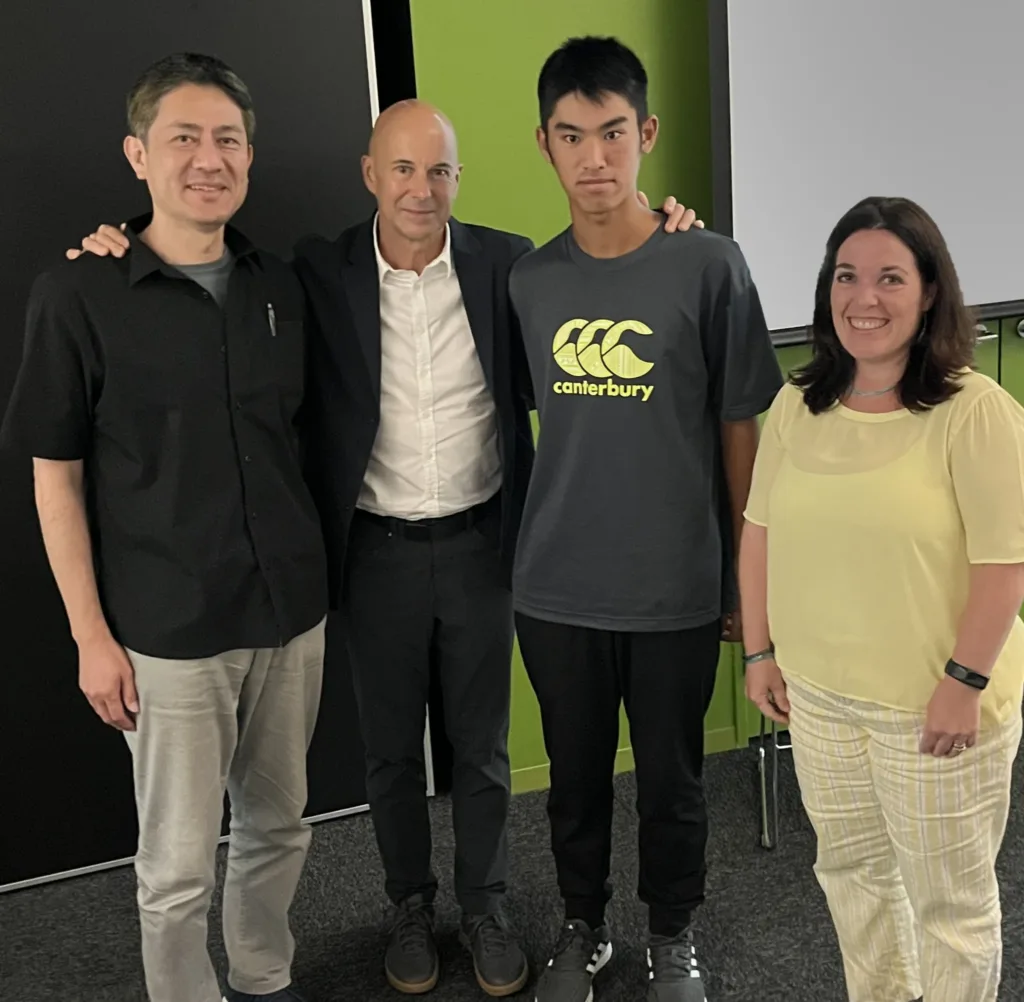
Ian: He hadn’t aged. It was like time had stopped in the 20 years since we last saw him. When I first met him, he was with his grandfather and his parents. My focus was on Mr. Kanda, so I didn’t really get a chance to connect with him.
In Halifax I realized we hadn’t offended anybody. I was so aware of that when we made the film. I thought, there’s a landmine and I’m going to find it. Two cultures, awkwardly communicating around something so powerfully emotional.
The Japanese ambassador spoke at the naming.
Maija: We were pretty softened up by then. We’d been travelling in a pack with the family for days. We thought we knew what to expect. The wild card was the Japanese ambassador.
He opened by saying he had two things on his calendar that weekend. One was the naming of this ship. The other was the memorial services for the 80th anniversary of the bombing of Nagasaki. Nagasaki was his hometown, which made the choice very hard. He decided to attend the ship naming, understanding it as a commitment to peace and a strong relationship between Canada and Japan today.
He understood the backstory and how these families are woven together. He captured the solemnness and the hope in a way our Canadian politicians just couldn’t. In the end I felt very lucky to have been there.
The story didn’t end with the film.
Maija: Every Canadian navy ship that sails to Japan goes to Onagawa Bay. They visit the memorial to Hampton Gray and the memorial to the sailors who died aboard the Amakusa. If it wasn’t for the memorial, I don’t know that Canadians would go there. And that’s Mr. Kanda. We always come back to Mr. Kanda.
Mr. Kanda had Canadian flags. Every time Canadians came to town, they signed one. It got so full he needed a second.
When the tsunami hit Onagawa, Yoshitake lost his parents. He searched the rubble for anything that might be left, and he found his grandfather’s flags. They had survived.
The tsunami also knocked over both memorials. The town could have let them go. Instead they moved them somewhere safe, so it would never happen again.
And now Victoria.
Maija: Hampton was a BC boy. I kind of feel like this ship came home.
Ian: It was the first time I’d seen him tied to BC in a big way. It’s always been Ottawa, back east.
Maija: It was a much smaller crowd than Halifax. A Monday in November. But we saw the chaplain’s blessing and the crew’s oath, their call and answer: “Ready, aye, ready.” Then we watched the crew board their ship for the first time, as a Canadian Navy ship.
Why put the film online now?
Ian: The ship kicked it off. Credit to the Canadian Navy for naming a vessel after him. We made the film 20 years ago and it kind of fizzled. It was never picked up in schools or by historians. The ship brought it back.
Maija: Part of why it fizzled is that Canada doesn’t do war heroes very well. Ask a hundred Canadians to name a Victoria Cross winner. And for most people, the war ended in May 1945. It didn’t end until August. Hampton was also a Canadian serving on a British ship, in a war most Canadians don’t think of as ours. All of that worked against the story.
Ian: The vets are gone. The historians from that time are gone. The family is getting older. There’s a next generation coming up. Yoshitake’s son Ibuki has already given a talk about the story at the Canadian embassy in Tokyo. In the next 20 years it’ll either be picked up by them or not.
Maija: It just keeps going. We’re not done yet.
The Last Battle of Hampton Gray is on our YouTube channel.